Zebra-Sens
Principal Investigators: Mireille Rossel and Benjamin Delprat
Technical Manager: Jérôme Sarniguet
Steering Committee: Anne-Françoise Roux, Mireille Rossel, Laurent Givalois, Tangui Maurice, Benjamin Delprat, Nadine Mestre-Frances, Jérôme Sarniguet
The ZebraSens platform was created at the initiative of two laboratories—MMDN (JM Verdier) and LGMR (AF Roux)—to conduct functional analyses of sensory and behavioral deficits in degenerative diseases.
This facility brings together, on a single site and near the MMDN“Ze-Neuro”Laboratory’s breeding facility, state-of-the-art equipment for analyzing vision, hearing, and locomotor behavior in zebrafish from the larval stage through adulthood, namely:
- 1 Visiobox®
- 1 Zebracube®
- 1 Zebrabox High Speed® (1,000 FPS)
- 2 Zebrabox® (30 FPS)
- 1 Zebrabox® equipped with a high-speed camera (140 FPS)
- 1 Seahorse®
Since March 2022, the Zebrasens facility has been part of the ZEFIX platform, a technology platform specializing in zebrafish and Xenopus aquatic models that is integrated into the UAR Biocampus Montpellier. ZEIX is a multi-site organization comprising four technical facilities for breeding and experimentation in Montpellier. Its goal is to provide the space, equipment, expertise, and training necessary to host and carry out projects related to the aquatic model organisms Danio rerio (zebrafish) and Xenopus laevis (xenopus).
EQUIPMENT AVAILABLE ON SET:
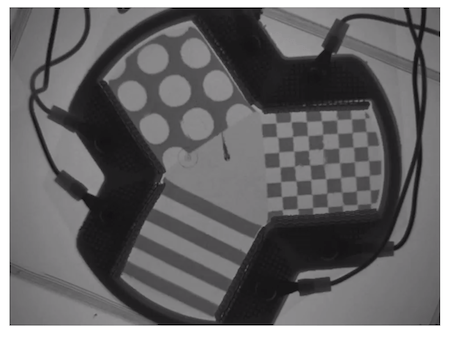
– The Visiobox® assesses vision by measuring the OKR (Optokinetic Response) response. This test automatically evaluates visual acuity in zebrafish in a stress-free environment.
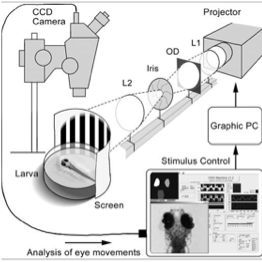
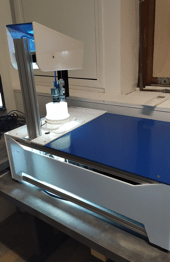
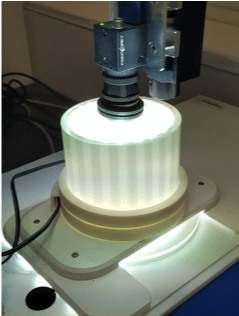
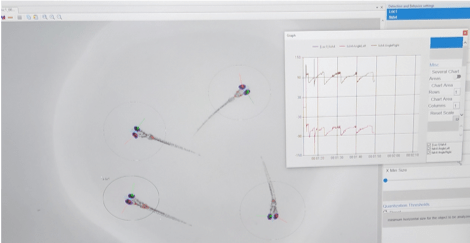
Visual acuity measured using OKR involves the eye movements of fish. These movements are triggered by the presentation of black-and-white stripes at regular intervals with high contrast. The size, contrast, and color of the stripes can be adjusted to increase the difficulty and accurately assess the visual acuity of a wild or mutant fish. Visual acuity can be measured in four fish simultaneously.
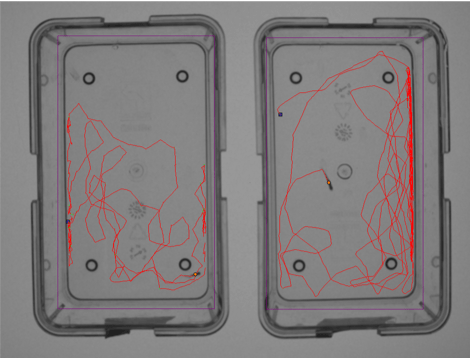
– The ZebraCube® allows for the study of three-dimensional (XYZ) locomotor activity in adult fish. The fish are tracked using video, making it possible to determine the distance traveled, the fish’s resting and active phases, and their position within the tanks. In addition, it is possible to measure social behavior (“shoaling”) as well as spatial memory (T-maze and double H-maze) and spatial memory involving pattern recognition and external stimuli (Y-maze).
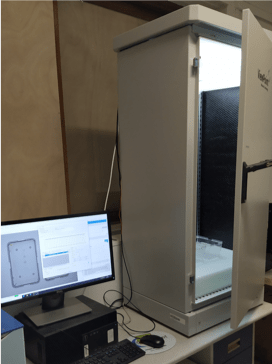
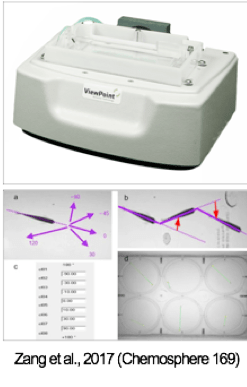
– The Zebrabox High Speed® allows for the measurement of auditory acuity in larvae starting at 5 dpf. This device features a vibration module and a high-resolution camera (1,000 frames per second). The system is thus capable of measuring the curvature of the larva’s body in response to a sound stimulus of a selected frequency and intensity. This curvature is characteristic of predator-avoidance behavior and provides information on the fish’s hearing acuity.
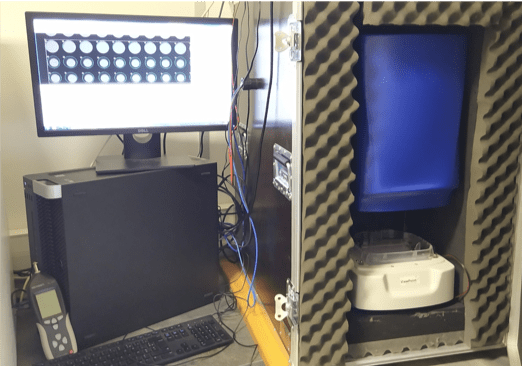
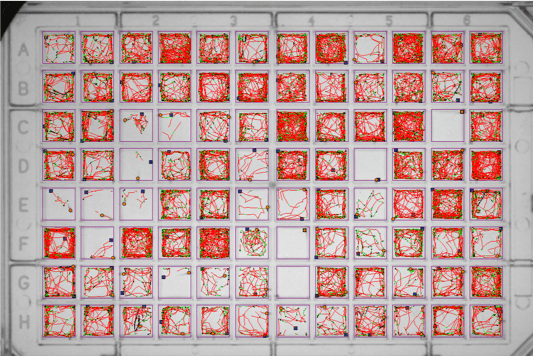
– Zebrabox® devices can measure the locomotor activity of larvae starting at 5 dpf (tracking) as well as their mobility (quantification). The VMR (Visual Motor Response) test measures this locomotor activity in response to sudden changes in light intensity, whether isolated or repeated. The larvae are tracked via video, making it possible to determine the distance traveled, the larvae’s resting and active phases, and their position in the well.
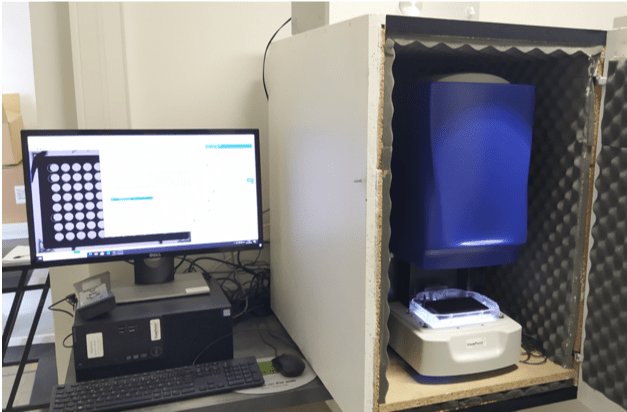
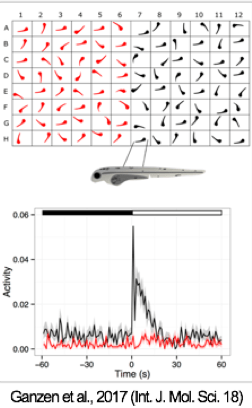
The ASR (Acoustic Startle Response) test is used to determine the hearing acuity of larvae in response to a sound stimulus of a specific frequency and intensity.
Note: A ZEBRABOX equipped with a single high-speed camera (140 fps ) can track rapid movements, such as epileptic movements.
Note: The Zebrabox® and the Zebracube® can also be used to track the locomotor activity of the Drosophila model.
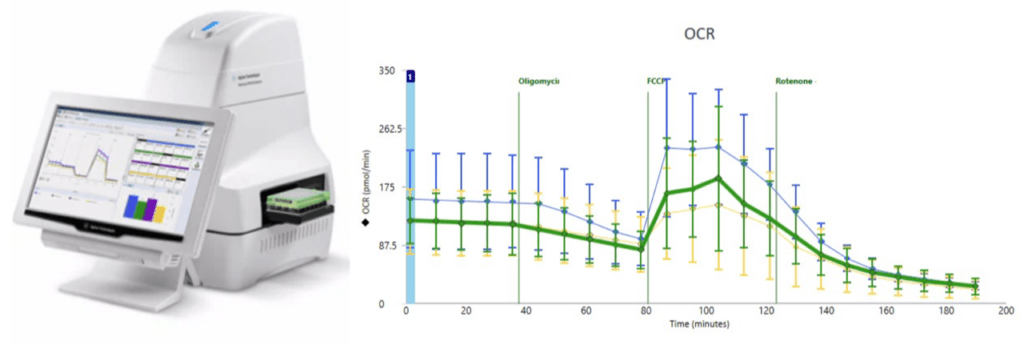
The Seahorse XFe24: enables the measurement of oxygen consumption rate (OCR) in live larvae using a 24-well plate format. The OCR is a key indicator of mitochondrial respiration and glycolysis, as well as the rate of ATP production.
Prices available upon request: jerome.sarniguet(at)inserm.fr
Acknowledgments: The“ZebraSens Phenotyping” platform was primarily funded by the SOS Rétinite France Association, with support from the Caisse d’Epargne.