microspringtail pet store
The mouse lemur (Microcebus murinus, Cheirogaleidae) is a model animal for primate studies. The mouse lemur is a small, nocturnal lemur (60 g to 100 g) at the base of the primate lineage. It is easy to breed in captivity due to its high fertility (1–3 offspring per year). Its longevity in captivity (7–12 years) allows for longitudinal experimental research, particularly on aging processes. The colony consists of about 100 animals. All age groups are represented.
The mandatory legal procedures to ensure compliance by personnel and facilities have been completed with the relevant veterinary and government agencies: facility approval, certificates of competence in animal husbandry for researchers and animal technicians, and regulatory authorization for animal experimentation for researchers and three animal technicians who meet the required qualifications for animal experimentation.
Two types of cages are used to house mouse lemurs:
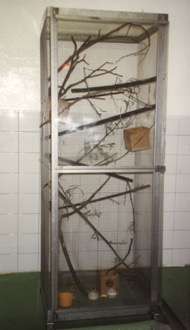
– On the one hand, aviaries (L=0.70 m; W=0.60 m; H=1.80 m) made of stainless steel, with 1 cm by 1 cm mesh suited to the physiology and movement of mouse-lemurs (particularly their jumping).
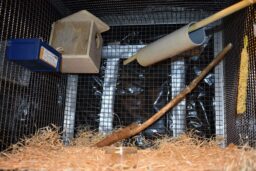
– and, on the other hand, large cages (L = 0.60 m; W = 0.60 m; H = 0.60 m) mounted on metal frames, designed to house two animals or mothers with their young.
The breeding season is influenced by the photoperiodic cycle. The annual alternation between a phase of activity (long days = summer = breeding season) and a phase of complete rest (short days = winter = no breeding) is a key characteristic of this primate. The tarsier reaches sexual maturity at 8 months. Tremors remain sexually active and fertile throughout their lives, even at very advanced ages (10 years). Female reproductive success increases with age (larger litters and improved survival of the young). Animals outside the breeding season are grouped by sex and similar weight. Consequently, there are “unisex” cages housing 2 to 5 individuals.
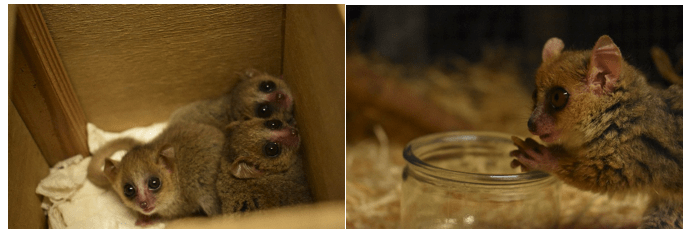
The diet is the same during the nonbreeding season as during the breeding season. The food ration (porridge and fruit) is tailored to each individual.
We provide training for students at vocational high schools who are preparing for careers as animal experimentation technicians. In addition, all users are trained in best practices for using the model (animal husbandry, experimentation, and legislation).
This collaborative platform has made it possible to develop projects in the following areas:
- Active Immunotherapy Targeting Amyloid in Young and Old Mouse-Squirrels
- Gene Transfer in the Brain: LRRK2, KLOTHO
- Characterization of Brain Aging: Cognition, MRI
- Regeneration Following Spinal Cord Injury
- The Effect of Aging on Heart Rate
- audiometric tests
The Team
N Mestre Frances, DE1 EPHE, certified specialist, scientific director of animal husbandry
nadine.mestre-frances@ephe.psl.eu
J Cuoq, EPHE-certified technician, certified in livestock management, technical manager of the livestock operation
F Hugon, Technical Assistant at EPHE, Animal Breeding
M. Peguet, Technical Assistant (fixed-term contract), EPHE, Animal Breeding
References
Mestre-Francés, N., Serratrice, N., Gennetier, A., Devau, G., Cobo, S., Trouche, S., Fontes, P., Zussy, C., De Deurwaerdere, P., Salinas, S., Mennechet, F.J.D., Dusonchet, J., Schneider, B. L., Saggio I., Kalatzis V., Luquin-Piudo M.R., Verdier J.M., Kremer E.J. (2018) Exogenous LRRK2G2019S induces Parkinson’s-like pathology in a nonhuman primate. JCI Insight 2018 3(14):e98202
Schmidtke, D., Zimmermann, E., Trouche, S.G., Fontes, P., Verdier, J.M., & Mestre-Francés, N. (2020). Linking cognition to age and amyloid-β burden in the brain of a non-human primate (Microcebus murinus). *Neurobiology of Aging*, Oct. 2020;94:207-216
Poulen G, Aloy E, Bringuier CM, Mestre-Francés N, Artus EVF, Cardoso M, Perez JC, Goze-Bac C, Boukhaddaoui H, Lonjon N, Gerber YN, Perrin FE. (2021) Inhibiting microglia proliferation after spinal cord injury improves recovery in mice and nonhuman primates. Theranostics. July 31, 2021;11(18):8640-8659.
DiFrancesco ML, Marrot M, Torre E, Mesirca P, Davaze R, Lautier C, Fontes P, Cuoq J, Fernandez A, Lamb N, Pifferi F, Mestre-Francés N, Mangoni ME, Torrente AG. (2023) Characterization of sinoatrial automaticity in Microcebus murinus to study the effect of aging on cardiac activity and the correlation with longevity. Sci Rep. Feb. 21, 2023;13(1):3054.
Trouche SG, Boutajangout A, Asuni A, Fontés P, Sigurdsson EM, Verdier JM, Mestre-Francés N (2023). Amyloid-β-targeting immunization in aged non-human primates (Microcebus murinus). Brain Behav Immun. Dec. 30, 2022;109:63-77